-
Why a One-Minute Catch Without Setup Misleads
-
Line Up the Boom Before You Catch Anything
-
Hold Pressure and Catch Each Nozzle for One Minute
-
Read Ounces as a Uniformity Check, Not a Promise
-
Write Down the Settings Before the Number Fades
-
When to Repeat the One-Minute Setup
-
What the One-Minute Method Cannot Tell You
Suppose an operator finishes a repair on a boom sprayer late in the afternoon, catches a few ounces from the nozzles, likes what the jar shows, and drives off without writing down the tip size or the pressure the gauge was holding. Nothing about that afternoon feels wrong. Two weeks later the note never existed, the tips have been cleaned or swapped, and the only record of that calibration is somebody's memory of a number that looked fine.
That is the whole risk in a one-minute output check. The catch is a measurement. It is not the calibration, and it never was. Ounces per nozzle turn into something you can trust and repeat only after three conditions are locked down: tips and components of the same size and design across the boom, a pressure you hold while the sprayer sits in place, and a written record made at the moment of testing. Skip any one of those and the numbers still look like data, which is exactly what makes them dangerous. What follows is the order that keeps the measurement honest.
Why a One-Minute Catch Without Setup Misleads
A nozzle's output comes down to two things: the size and design of the opening, and the pressure pushing liquid through it. Flow through a fixed orifice rises and falls with pressure, so the same tip under a different push delivers a different volume in the same stretch of time. That is the reason a catch taken with mismatched tips or a drifting gauge reads the setup, not the nozzle. You end up measuring whatever happened to be installed and whatever the pump was doing at that moment.
Two tips that look alike on the boom can differ in size and design, and a partially plugged or swapped component changes what flows through a position. Collect ounces first and every difference you find has two possible parents, the hardware and the way you ran the test, with no way to tell them apart. Line the boom up first and the same variation points at one thing.
Line Up the Boom Before You Catch Anything
Don't reach for the measuring jar yet. Walk the boom first, tip by tip, and confirm that every tip and component installed on it is the same size and design. Then record the type and size of each spray tip before anything gets collected. This is the step most often skipped, and it is the one that decides whether the numbers later mean anything.
With the boom verified, set the pressure you actually intend to spray at and run the sprayer in place. Not a number that looks good on a gauge while the machine is moving and the pump is catching up, but the setting you plan to use in the field, held while the sprayer sits still. Which pressure that is depends on your label, your tip chart, and the speed you plan to run. The one-minute method gives no pressure value, so use the setting you intend to spray.
The sequence only holds in one direction. Check the hardware and note it down while nothing is flowing, because the catch that follows is only as good as the lineup behind it. Start catching first and you measure a boom you have not yet verified.
Hold Pressure and Catch Each Nozzle for One Minute
Now the catch itself. Operate the sprayer in place at the desired operating pressure, collect spray from each nozzle for exactly one minute, and measure the ounces you get with a calibration jar or a container marked in ounces.
Exactly is the word carrying the weight here. Flow is a rate, so the volume in your jar is rate multiplied by time. Because the catch is time-based, a sample that runs past the minute or stops early is no longer comparable to the one before it, and an unmarked container turns the whole exercise into an eyeball estimate. Keep each sample tied to its position as well, noting which nozzle produced which ounce figure, or you end up with a bag of numbers that have no addresses.
What the method does not hand you is a nozzle count or a container brand. Your boom decides the count, and any container marked in ounces will do the job. Fill those gaps from your own machine rather than from a generic table.
Read Ounces as a Uniformity Check, Not a Promise
If the tips are the same size and design and the pressure held, the one-minute catches should land close to each other. The reason is physical: they are the same orifice under the same push, so nothing at a given position justifies delivering far more or far less than its neighbors.
An outlier is information. Something at that position differs, whether the tip, a component, or the flow path, and the reading is telling you where to look. Which means treat the outlier as a setup question first. It is not proof of wear life, it is not a yield figure, and it does not by itself tell you to replace anything. Confirm the setup is controlled before you call those numbers a baseline.
The honest answer about spread is also the boring one: this method supplies no acceptable variation range. There is no tolerance to compare against, so do not invent a pass or fail line, and do not let anyone hand you one as if it came with the jar. What you can say is that a wide spread across the boom deserves a look before you spray.
Write Down the Settings Before the Number Fades
Record the type and size of each spray tip. Once the sprayer is adjusted to the correct calibration, write down the settings along with the date and time of testing, so the same optimized setup can be used again later. That record matters in exactly the situations nobody plans for: something gets lost, or the sprayer goes in for repair.
The reason a written record beats a good memory is that memory has no format. A note saying the sprayer ran fine restores nothing. Date and time, tip type and size, the pressure you held, the nozzle position, and the one-minute ounce figure for each position: that is a setup you can rebuild.
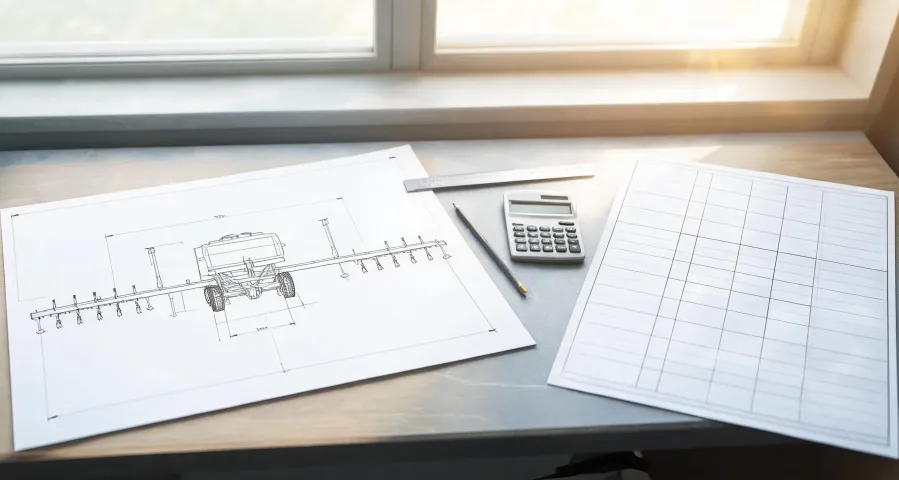
No form ships with the method, so build a simple sheet and keep it with the machine. Those fields are field placeholders, not specifications handed down by anyone. What matters is that the next person, or you next season after a repair, can read the sheet and reproduce the same tip and pressure combination.
When to Repeat the One-Minute Setup
Repeat the check when the setup changes. A different tip type or size, a repair on the sprayer, a new intended pressure, or a missing record all qualify. A repair is the clearest trigger of the four, because the recorded settings exist precisely to restore a known setup after repair or loss. Once the machine has been apart, the old sheet describes a sprayer that no longer exists in quite the same form.
There is no calendar interval in this method, so do not let a made-up schedule stand in for a real trigger. Judge by change, not by the month on the wall. Weigh the cost plainly, too: every extra check takes time out of a day that is already short, while skipping checks leaves you holding an unverified record that looks more solid than it is.
What the One-Minute Method Cannot Tell You
This method cannot establish cost savings, a yield response, a ranking among sprayers, or how long a tip will last. Because the catch measures output at one moment and one pressure, it cannot by itself prove biological efficacy or economic return. A clean set of ounce readings says the hardware is lined up and the test was controlled. It says nothing about what the spray does after it leaves the nozzle.
That boundary matters at the dealership counter. If a purchase decision is being rested on a one-minute catch, the honest use of that number is narrower: document a setup and repeat it. Ask instead for the manual guidance on stationary operation for the specific model you are considering, and the tip chart that goes with it. Those are documents you can check line by line; a demonstration jar reading is not.
So come back to the operator from that afternoon. The fix was never a fancier catch jar. It was a controlled check before the catch and a single page of notes afterward, written while the machine was still standing in the yard with the gauge where it was left. Here is the judgment to carry out of this article: if tip type and size, intended pressure, date and time, and each nozzle's one-minute ounce reading are not written down, the sprayer is not calibrated, and the setup should be run again. The record costs a few minutes. Without it, the next check has nothing to be compared against.

Discuss the purchasing question